Today, we're releasing Kolly 2.0.
Kolly is an AI for college admissions. The new version is built around our own model, trained on hundreds of thousands of essays from students admitted to top schools, and a redesigned product that reads the whole application the way an admissions officer does.
We started Kolly because the system that decides where high school students go to college runs on private feedback most families cannot afford. A counselor in our hometown charges $40,000 a year. Most students get nothing close to that. We're trying to close that gap with software, and 2.0 is the version we wished we had when we were applying.
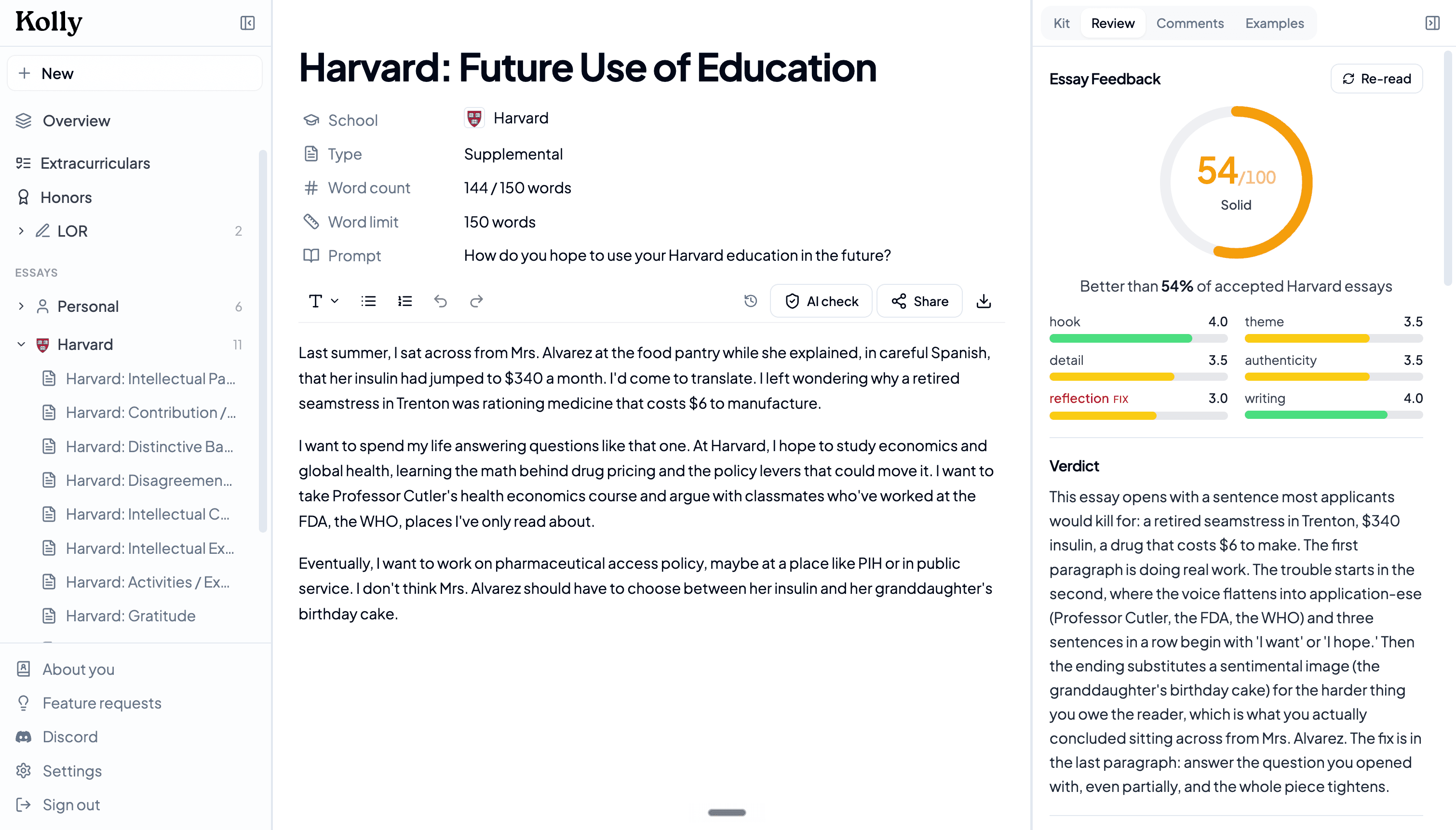
A model trained on accepted students
Most AI tools that help students with college essays are wrappers around general models. They were trained on the open internet, so they grade your essay against random writing on the open internet. That is not what admissions readers do.
Our model was trained on hundreds of thousands of essays from students who actually got into Stanford, Harvard, MIT, Penn, Yale, and the rest of the top tier. It scores writing against the standard of admitted students. It knows what a Stanford-admit personal statement sounds like and what one that almost got in sounds like.
Essays are scored across six dimensions admissions readers actually use: hook, theme, detail, voice, reflection, and writing quality. The model returns a percentile against admitted essays for the school you're applying to, plus the accepted essay closest to yours so you can see what worked for someone with a similar story.
The whole-file read
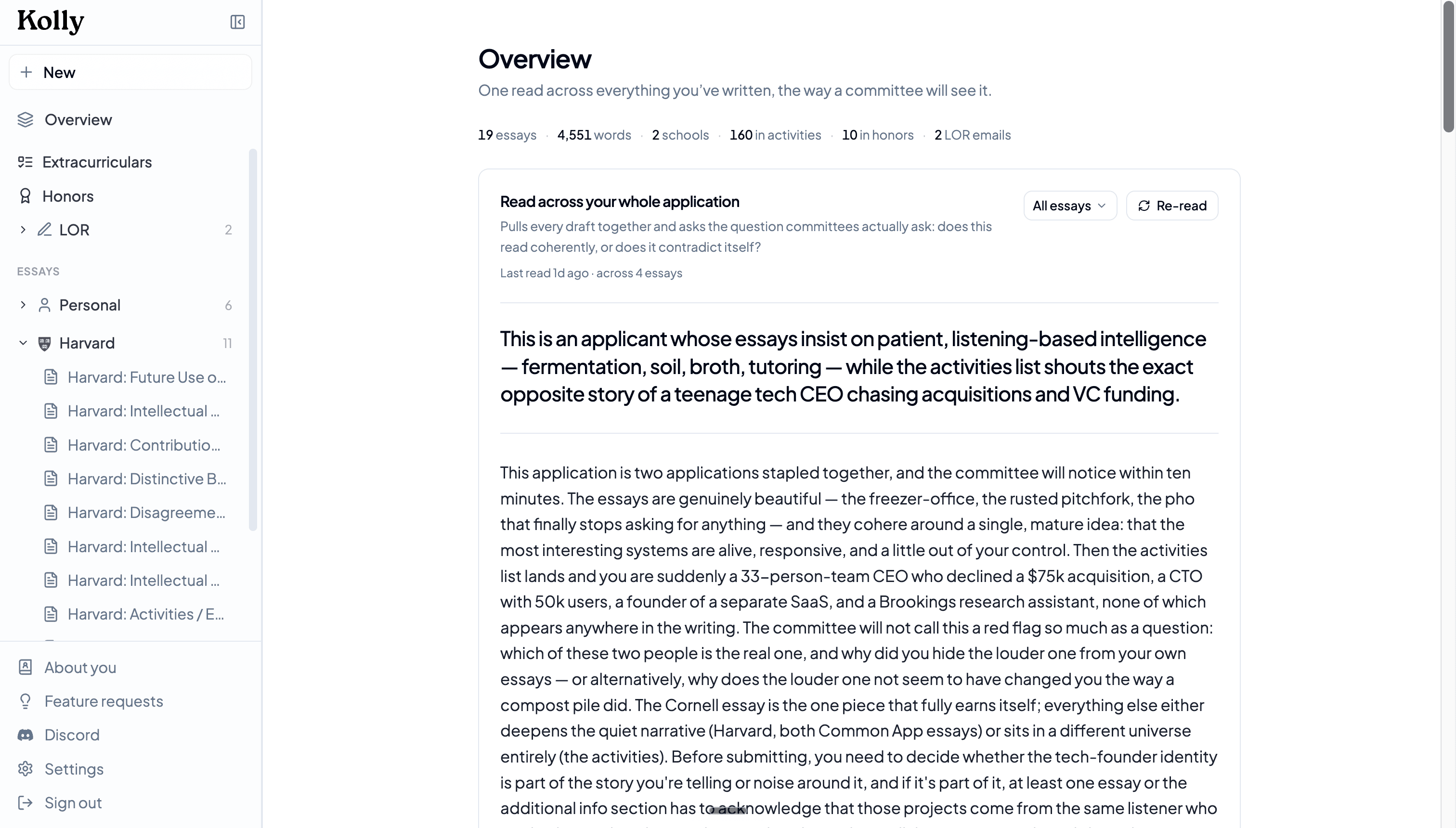
Admissions reads one file. They form one impression of one student. The personal statement, the supplements, the activities, the honors, the recommendations. All of it lands as a single judgment.
Most tools grade essays in isolation. That was the problem with Kolly v1, too. We were giving students clean essay scores while the rest of the file was working against them. A great personal statement does not compensate for a generic Why Us essay or an activities list that reads like a resume.
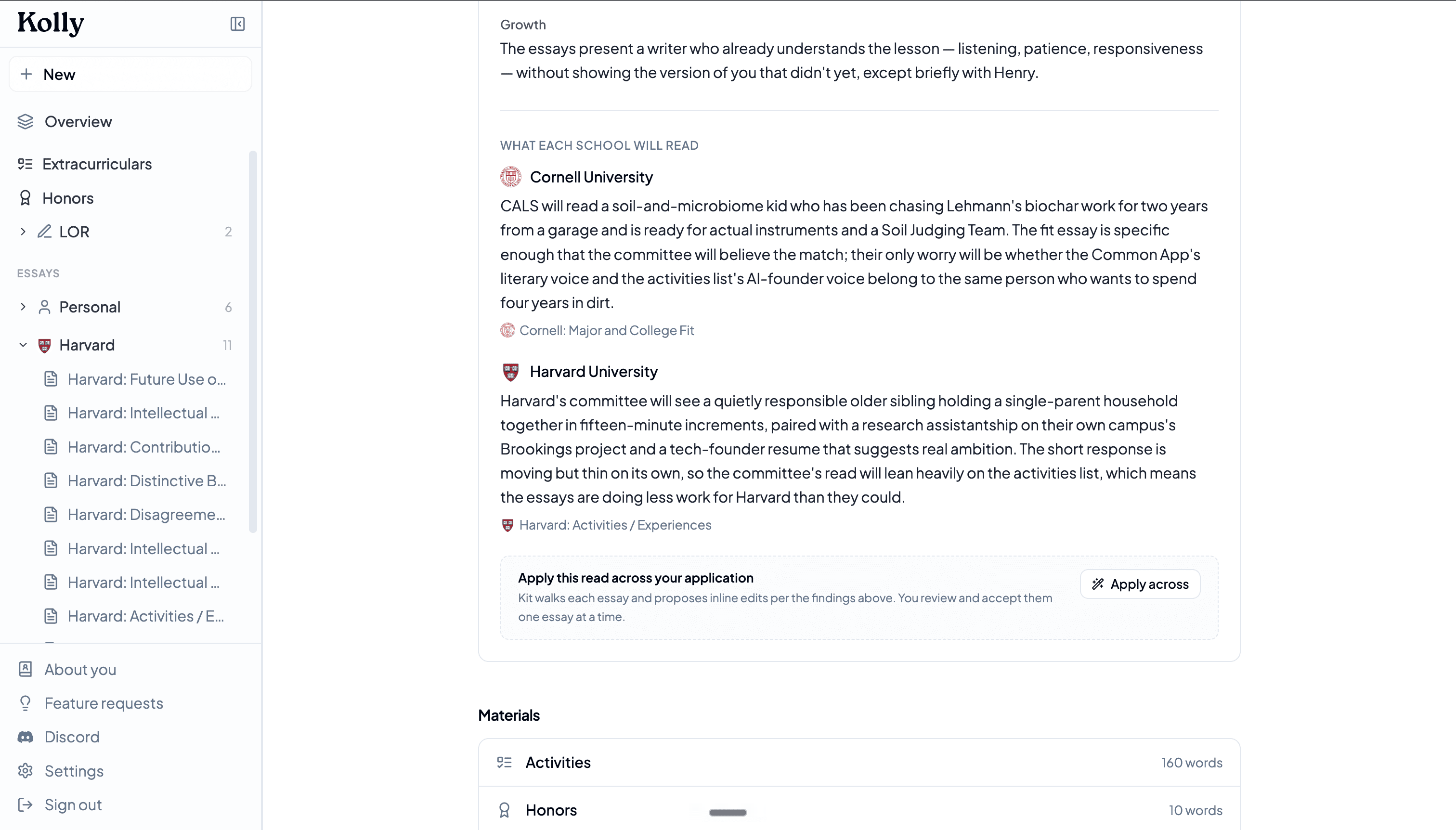
2.0 reads the whole file at once. It sees how the essay frames the activities, how the activities support the honors, where the supplements line up with the personal statement, and where the file contradicts itself. It tells you what is strong, what is weak, and what to fix before submission day.
Kit, a writing partner that knows your voice
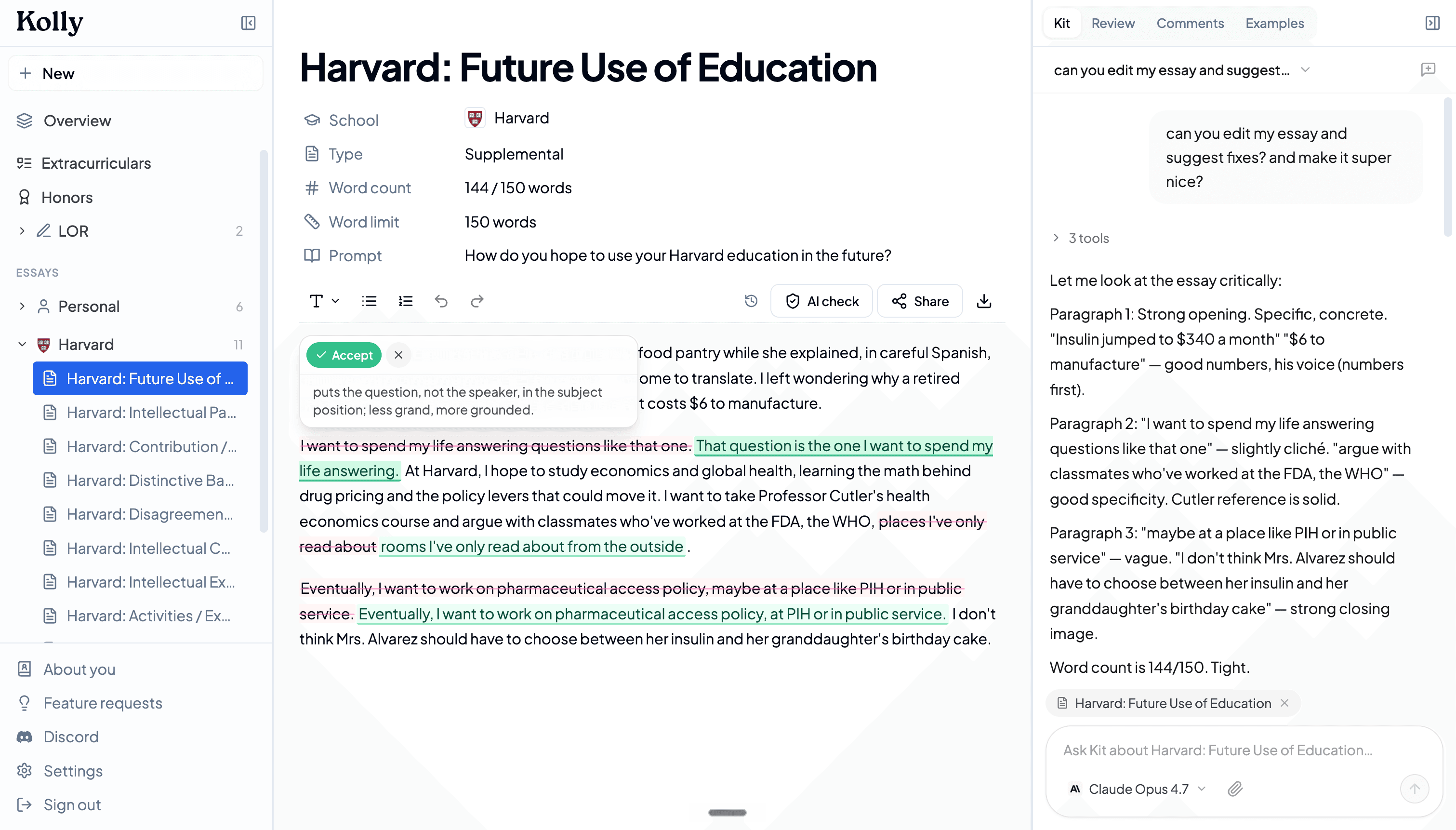
Kit is the editor inside Kolly. You can ask it for a sharper opening, a tighter paragraph, or a second read on a single sentence. It edits in your voice. It does not rewrite your essay for you.
Most students who use Kit tell us their final essay sounds more like them than the draft they brought in. That is the bar. ChatGPT writes essays for students. Kit helps students write better essays themselves.
School-by-school strategy
Stanford and Harvard want different things. Princeton and Yale read for different signals. Most students send the same supplements to ten schools and hope for the best. That is the easiest way to look generic to every reader on every committee.
Kolly reads your file against what each school is actually looking for and tells you which essays to tighten for which schools. It flags Why Us essays that could be sent to four other colleges without changing a word. It catches major statements written too vaguely to land at a school that cares about academic specificity.
What it will say that ChatGPT will not
ChatGPT is trained to be agreeable. Ask it to grade your essay and it will find something nice to say. That is dangerous, because polished bad work still loses.
Kolly will tell you when a paragraph has no point. When an activity sounds inflated. When a supplement could be sent to four other schools without changing a word. When an honors list is wasting space. When the file does not yet make sense as one application.
That kind of read is what families pay private counselors for. We think every student should get it, including students whose families cannot pay $40,000 a year.
A new design
Everything is faster. Everything is cleaner. The editor uses our own typography. Mobile works. We rebuilt the interface to feel like a tool a serious applicant would actually want to spend time in.
What we believe
Grades and scores no longer separate students at top schools. Every serious applicant has the numbers. The application is the difference now.
The students who get in are not always more talented than the students who do not. Often they are presented better. Their essays are sharper. Their activities are framed correctly. Their file has a point.
That should not be a privilege of families who can afford a $40,000 counselor.
Kolly 2.0 is live at kolly.app. Free to start.